How an Electrician Turns Repeated Mining Questions Into an Ambassador Role
A 301 TH/s rack clears about $10.98 a day after the listed charge on the block-reward side, using chain values read on 21 Sept 2026. That one figure answers most of the mining questions an electrician hears during a service call. The rest of the conversation is about load, heat, noise, and who carries the paperwork.
Key takeaways
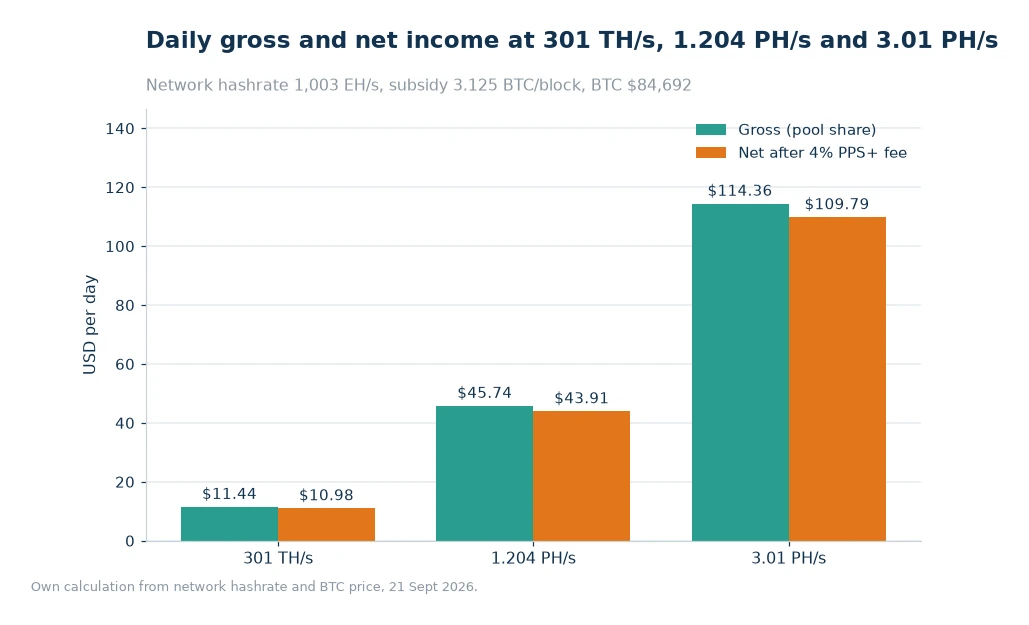
- At 301 TH/s the daily gross is $11.44 and the net after the listed block-reward charge is $10.98.
- That rack is roughly ten 30 TH/s units, and at 20 J/TH it pulls about 6 kW without a break.
- Ambassador work rewards plain explanation: a client who understands the 4% and 2% split rarely blames the pool for a quiet month.
- Apply only once you can show two or three real explanations you have already given to real people.
Why the mining question reaches the panel fitter first
A mining rack is an awkward load. It runs flat out for weeks, it dumps heat into whatever room holds it, and it has no off switch a household actually wants to use. An electrician notices those three facts immediately, which is why the conversation often starts at the consumer unit instead of a pool dashboard. The customer wants to know whether the garage circuit will hold, whether the hum will travel through a shared wall, and whether the whole exercise is worth the trouble. Only the last question needs mining knowledge, and it needs less of it than people assume.
The answer that lands is not a forecast. It is a division: the rig's share of the network, multiplied by the coins the network issues each day, minus the listed charge. A 301 TH/s machine against 1,003 EH/s of network hashrate holds a share near 0.00003%, and that tiny fraction still turns into a figure a household recognises once it is priced in dollars.
There is a second reason the trade gets asked. A customer who has already bought a miner has usually been told a monthly income figure with no working behind it, and the gap between that figure and the first statement is where trust leaks away. An installer who can rebuild the number in front of them, slowly enough to follow, does something no marketing page can. That is the raw material of a credible application, and it costs nothing but patience.
What the programme asks for, and what it does not
The ViaBTC Ambassador Program is a formal route for people who already explain mining to others. The visible step is the Apply for Ambassador form; the substance behind it is a record of accurate explanations. Nothing about the role needs a price target, a trading opinion or a claim about next year, and anyone who supplies those has drifted away from what the programme is for.
Read the page before filling anything in. It sets out the requirements, the material the team wants and the way an application is reviewed. Treat it like a tender document: answer what is asked, attach evidence, and drop the sales language. A short, specific submission beats a glossy one that says nothing checkable.
The arithmetic worth memorising
Two numbers cover almost every casual question. The first is daily issuance: 144 blocks at 3.125 BTC each comes to 450 BTC a day. The second is what one terahash represents, which is 450 divided by 1,003,000,000 TH/s, or roughly 0.00000044865 BTC per TH per day.
Every rig is then one multiplication away. A 100 TH/s machine lands near 0.0000449 BTC a day. A 301 TH/s rack lands near 0.000135 BTC. A 3.01 PH/s container lands near 0.00135 BTC. Price those at $84,692 and the household question answers itself. Keep four inputs on a card: issuance, network hashrate, price, and the listed rate that applies to the component being paid. That card is the whole toolkit.
A four-row brief for a curious client
Most people stop listening after one number, so give them a row they can find themselves in. The table below reads left to right from kit to cash, and the machine count assumes common 30 TH/s units.
| Rack size | Hashrate | BTC per day | Gross USD | Net USD |
|---|---|---|---|---|
| Ten units | 301 TH/s | 0.00013503 | $11.44 | $10.98 |
| Forty units | 1.204 PH/s | 0.00054012 | $45.74 | $43.91 |
| One hundred units | 3.01 PH/s | 0.00135030 | $114.36 | $109.79 |
The middle and bottom rows are clean multiples of the first, which is useful when a client asks what another pallet would add. Forty machines add three times the first row, not a new calculation.
Worked example
Take the smallest row and rebuild it from the network figures, so the client can see that nothing was guessed.
- Issuance: 144 blocks × 3.125 BTC = 450 BTC a day.
- Share per TH/s: 450 ÷ 1,003,000,000 = 0.00000044865 BTC.
- Rack total: 301 × 0.00000044865 = 0.00013504 BTC, recorded as 0.00013503 after rounding.
- Gross dollars: 0.00013503 × 84,692 = $11.44.
- Listed charge on the block-reward part: 11.44 × 0.04 = $0.46.
- Net: 11.44 − 0.46 = $10.98, which is the shorter bar.
- Scale check: 1.204 PH/s is four times 301 TH/s, so 4 × 10.98 = $43.91; 3.01 PH/s is ten times, so 10 × 10.98 = $109.79.
Building an application that survives a read-through
Three things carry weight. Describe the audience concretely: a village group of 400, a monthly repair cafe, a supplier newsletter with a defined list. Show one explanation you have already written or delivered, ideally with the arithmetic left in rather than stripped out. Name the questions you get most often and how you answer them, because that is the actual work.
The form is short, so the writing around it does the persuading. Avoid reach you cannot evidence and platforms you post to twice a year. A smaller, steady audience that asks follow-up questions is a better story than a large passive one, and it is easier to keep accurate over time.
Where a helpful answer turns into a careless one
Two habits spoil otherwise good referrals. The first is quoting a dollar figure without its date; the values in this article were read on 21 Sept 2026 and will not hold forever. The second is presenting a net figure as a floor. It is arithmetic at one moment, not a promise, and a difficulty change of a couple of percent moves it.
Keep the settlement methods apart as well. PPS+ settles the block-reward part hourly and carries a listed 4% there, while the transaction-fee part follows PPLNS logic at a listed 2%. PPLNS on its own applies a listed 2% to the combined total and pays after six confirmations. A client who hears those as one blended rate will mis-check their first statement. If they want to start rather than chat, point them at the ViaBTC Referral page and let the numbers do the rest.
Frequently asked questions
How many machines does 301 TH/s represent?
About ten 30 TH/s units, and at 20 J/TH that is roughly 6 kW of continuous draw, a figure worth checking against the circuit before anything is plugged in.
Do I need mining hardware to take part?
The role is about communication rather than equipment, and the walk-through in this article is the kind of explanation the programme page asks applicants to demonstrate.
What charge applies at 301 TH/s?
Under PPS+ the listed charge is 4% on the block-reward component and 2% on the transaction-fee component; on the block-reward side alone that turns $11.44 gross into $10.98 net at the values used here.
Answer the question, then hand over the page
An electrician's edge is credibility on the physical side: load, heat, protection, noise. Lead with that, give the arithmetic second, and point to the programme page for the formal step. The customer gets a straight answer and the application writes itself, because the conversations have already happened.
Hand over two things at the end of a call: the calculation on paper and a way to watch the result. The ViaBTC App covers the second part on a phone. After that, the work is simply to keep answering, accurately, in public.
Sources: the programme and fee pages at viabtc.com for the listed rates[1]. Inputs logged 21 Sept 2026: 1,003 EH/s network hashrate, 3.125 BTC subsidy, 144 blocks daily, BTC at $84,692. Published 24 Oct 2026; all figures are arithmetic on those inputs.