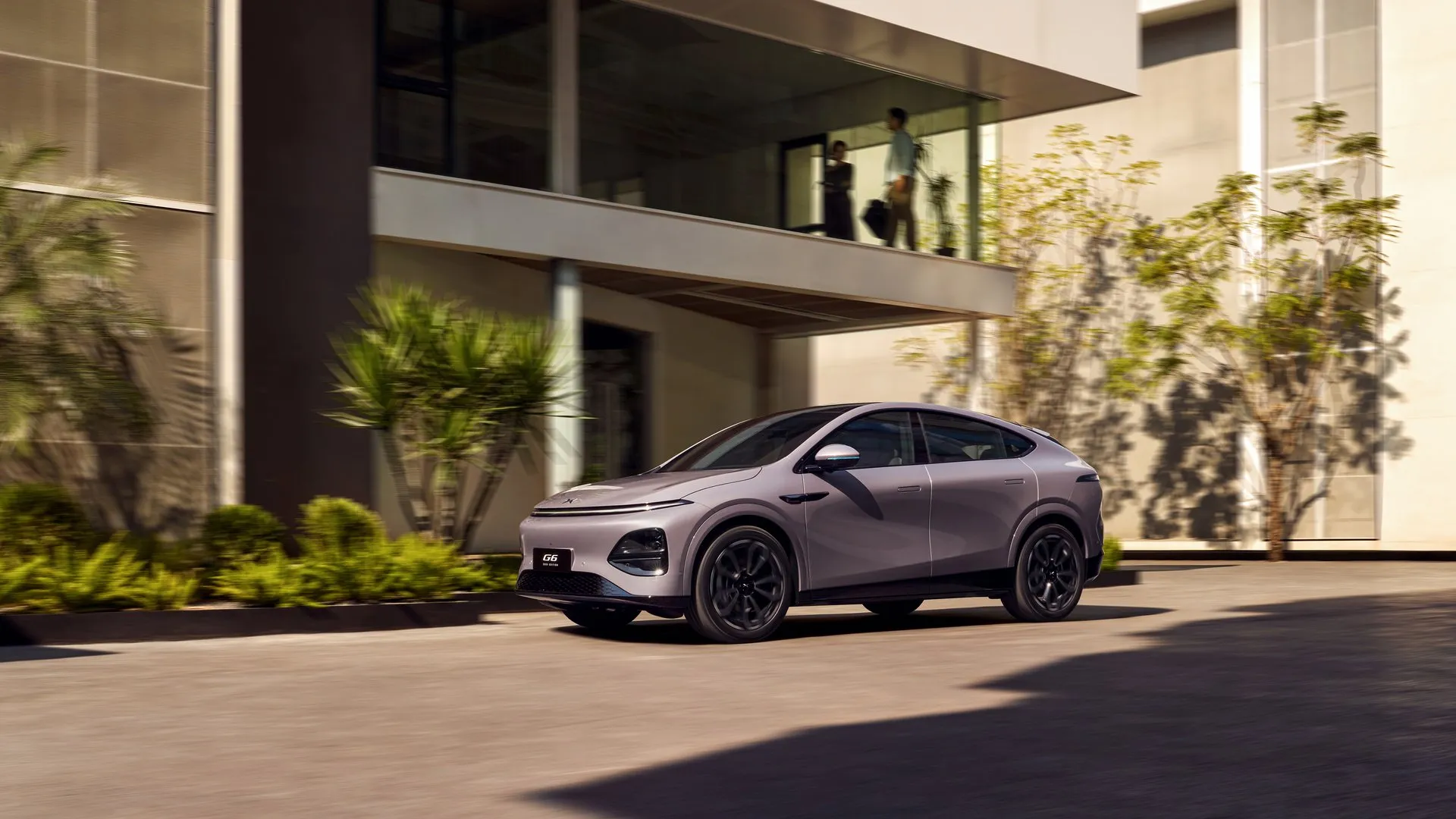
Yes. XPENG now has two Australian models that cover very different family sizes. The 2026 G6 seats five, offers up to 525 km WLTP range, carries 571 litres of luggage with the rear seats raised, and can recharge from 10% to 80% in a claimed 12 minutes. The larger X9 seats seven, provides 721 litres behind all three rows, and reaches up to 580 km WLTP. ANCAP gave the G6 88% for adult occupant protection and 86% for child occupant protection. For families with home charging and mainly sealed-road travel, the specifications now cover most daily, holiday and school-run requirements.
Family suitability starts with physical space rather than battery size. The 2026 G6 is 4,758 mm long, 1,920 mm wide and 1,650 mm high, with a 2,890 mm wheelbase; its long wheelbase and flat rear floor leave usable legroom for adults sitting behind adults rather than reserving the second row mainly for children. CarExpert's Australian review found rear headroom generous for a 173 cm tester and reported substantial legroom behind the driver's seating position.
That second-row layout matters when two child restraints stay installed for several years. The Australian G6 specification includes rear ISOFIX mounting points, seven airbags and rear-seat facilities such as USB-C charging, while the absence of a conventional transmission tunnel leaves the centre footwell flat. A five-person household can therefore use all three rear positions more easily, although families using three bulky child restraints should still install their own seats during a test drive rather than relying on cabin-width figures.
Boot measurements provide another useful check. The G6 carries 571 litres with five seats available and 1,374 litres after the rear seats are folded, while its rated payload is about 475 kg in the RWD Long Range version.
A 475 kg payload can disappear faster than the boot volume suggests. Two adults at 80 kg each, three children averaging 35 kg, and 100 kg of luggage already total 365 kg, leaving roughly 110 kg before accessories or other equipment are considered; families carrying bicycles, camping equipment or heavy roof-mounted items should calculate mass as well as litres.
For households needing more than five seats, the 2026 X9 changes the comparison considerably. It has seven seats and 721 litres of luggage capacity even when every seat is occupied, while folding seats can expand the available cargo space to as much as 2,554 litres. XPENG states that the normal seven-seat boot can accommodate seven 20-inch carry-on cases.
The X9 also has a 575 kg payload in AWD Performance form, so seven occupants still require some arithmetic. Seven people averaging 65 kg would account for 455 kg, leaving approximately 120 kg for luggage before considering fitted accessories; a family carrying four adults, three children and holiday bags may have more usable margin than a group of seven adults.
A large boot does not automatically provide a large carrying allowance. Passenger mass, luggage, accessories and tow-ball weight all contribute to the vehicle's permitted load.
Range is less restrictive once normal Australian family kilometres are separated from official laboratory figures. The G6 RWD Long Range combines an 80.8 kWh LFP battery with a stated 525 km WLTP range and consumption of 17.9 kWh/100 km, while the AWD Performance version is rated at 510 km and 18.4 kWh/100 km.
A family covering 50 km on a busy weekday would use about 8.95 kWh at the Long Range model's published consumption rate. Over five weekdays, 250 km corresponds to approximately 44.75 kWh before charging losses, leaving a substantial portion of an 80.8 kWh battery available for unplanned trips.
WLTP figures should not be read as a promise of 525 km on every motorway journey. XPENG's Australian specification notes that speed, passenger count, vehicle load, outside temperature, air-conditioning, terrain and vehicle condition can change actual range, so a heavily loaded 2026 holiday trip at sustained motorway speeds should be planned with a larger reserve than suburban driving.
Charging performance helps reduce the consequence of that variation. The G6 Long Range supports up to 451 kW DC charging and XPENG specifies 10–80% in 12 minutes under suitable conditions; moving through 70% of an 80.8 kWh battery represents roughly 56.6 kWh entering the usable charging window, although real charger output will not remain at the peak rate for the entire session.
Public infrastructure therefore matters as much as the car's inlet rating. A 150 kW charger cannot supply 451 kW merely because the G6 can accept it, and XPENG states that charging time varies with charger type, battery temperature, battery condition, ambient temperature and initial state of charge. Families planning regional travel should examine the actual chargers on their route rather than using the 12-minute figure as a universal stop time.
Home charging produces a different routine. The G6 supports 11 kW AC charging, with XPENG listing about 9.2 hours from 5% to 100% for the 80.8 kWh versions under the specified conditions, so overnight charging can cover a near-empty battery without requiring a public stop.
Running-cost estimates can then be calculated from a household's own tariff. At a hypothetical electricity price of $0.30/kWh, the published 17.9 kWh/100 km consumption equates to about $5.37 of electricity per 100 km before charging losses; at $0.60/kWh on a public charger, the same energy becomes about $10.74. A household travelling 15,000 km in 2026 would consume approximately 2,685 kWh at the official rate.
Families researching XPENG electric cars australia should also separate five-seat and seven-seat use rather than treating the range as one product. The G6 RWD Long Range was listed at $51,800 before applicable on-road costs in the Australian configurator, whereas the seven-seat X9 started at $89,900 before on-road costs when Australian pricing was announced on 21 July 2026.
That $38,100 difference purchases much more than two extra seats. The X9 Standard Range has a 94.8 kWh LFP battery, while the AWD Performance uses a 110 kWh battery and offers up to 580 km WLTP; the larger vehicle also includes active rear-wheel steering, dual-chamber air suspension, nine airbags and a 21.4-inch rear entertainment display.
| Family-use measure | G6 RWD Long Range | X9 AWD Performance |
|---|---|---|
| Seats | 5 | 7 |
| WLTP range | 525 km | 580 km |
| Battery | 80.8 kWh LFP | 110 kWh NCM |
| Peak DC charge | 451 kW | 542 kW |
| 10–80% claimed time | 12 min | 12 min |
| Boot with seats in use | 571 L | 721 L |
| Payload | 475 kg | 575 kg |
| Australian listed price | $51,800 | $109,900 |
The X9's size could normally make school car parks and narrow suburban streets less convenient, so rear-wheel steering deserves attention beyond the specification sheet. Its published turning radius is 5.4 metres despite seven seats, compared with 5.8 metres for the smaller G6; the X9 AWD also weighs 2,745 kg, so tyre wear, parking dimensions and garage clearance still deserve measurement before purchase.
Safety data are stronger for the G6 because an independent Australian assessment is already available. ANCAP's rating for G6 vehicles from October 2024 onwards records 88% adult occupant protection, 86% child occupant protection, 81% vulnerable road-user protection and 80% safety assistance, with the assessment including frontal tests conducted at 50 km/h.
The Australian specification also lists automatic emergency braking, forward collision warning, blind-spot detection, lane-departure warning, rear cross-traffic alert and driver-state monitoring. Those systems assist rather than replace the person at the wheel; XPENG's own 2026 documentation tells users to remain responsible for vehicle control and notes limitations in poor visibility, wet roads, difficult weather and complex traffic.
ANCAP percentages are more useful than counting the number of electronic assistance features. The G6's 86% child-occupant result comes from an independent assessment, while feature availability and software behaviour can change between model years.
Long-distance family travel also depends on what can be carried behind the car. Published specifications list a maximum braked towing capacity of 1,500 kg and 750 kg unbraked for the G6, which can suit a light trailer but not every caravan commonly used for extended touring.
Towing should be evaluated together with range because aerodynamic resistance rises sharply once a tall trailer sits behind an EV. A family that normally sees consumption near the G6's official 17.9 kWh/100 km should not budget a 2026 towing holiday from that number alone; route distance, trailer shape, weight, road speed, wind and charging access all change energy use.
Vehicle-to-load adds another practical use away from home. The G6 and X9 specifications list up to 6 kW V2L output, allowing suitable external equipment to use energy from the traction battery; for a campsite or outdoor event, a 1 kW appliance operating for three hours would theoretically take about 3 kWh before conversion losses, less than 4% of an 80.8 kWh G6 battery.
Ownership support deserves the same attention as battery performance because Australian families commonly keep vehicles well beyond a three-year finance cycle. XPENG states that eligible vehicles sold by XPENG ANZ from 1 June 2026 receive a seven-year, unlimited-kilometre vehicle warranty for private owners, while the traction battery, battery-management system, motor and Intelligent Power Unit receive eight years or 160,000 km of coverage.
Service location still needs checking before purchase, particularly for households far from major metropolitan areas. XPENG announced in July 2026 that it planned to expand its Australian sales, delivery and service network, but a planned expansion is not the same as having a workshop close to every regional owner; the distance to the nearest authorised service point belongs beside range and price when comparing family vehicles.
A family of four with a garage, daily travel below 100 km and occasional interstate trips has fewer practical compromises in the G6 than EV buyers faced several years ago. Five seats, 571 litres of boot space, 525 km WLTP, 451 kW peak DC capability and the 86% ANCAP child-occupant score cover the areas parents use repeatedly rather than features they may rarely touch.
A family of six or seven needs a different vehicle, and the X9 supplies the additional row without reducing its boot to a token compartment: 721 litres remain with seven seats operating, while its 2026 Australian specification reaches 580 km WLTP in AWD Performance form. At $89,900 for the FWD version and $109,900 for AWD before on-road costs, the extra room also moves the purchase into a much higher price bracket.
Households without private charging face the largest change in daily convenience. A 12-minute 10–80% claim is useful only when a sufficiently powerful charger is available and working, while a home with 11 kW AC charging can replenish the G6 overnight; apartment residents relying entirely on public infrastructure should map regular charging locations before comparing touchscreen features, acceleration figures or audio systems.
For Australian family use in 2026, the numbers are already strong enough to move the discussion away from whether an XPENG can perform ordinary family transport. The remaining differences are household-specific: five or seven seats, 475 kg or 575 kg payload, nearby charging, towing requirements, service distance and whether a purchase price starting around $51,800 or $89,900 fits the family's vehicle budget.